
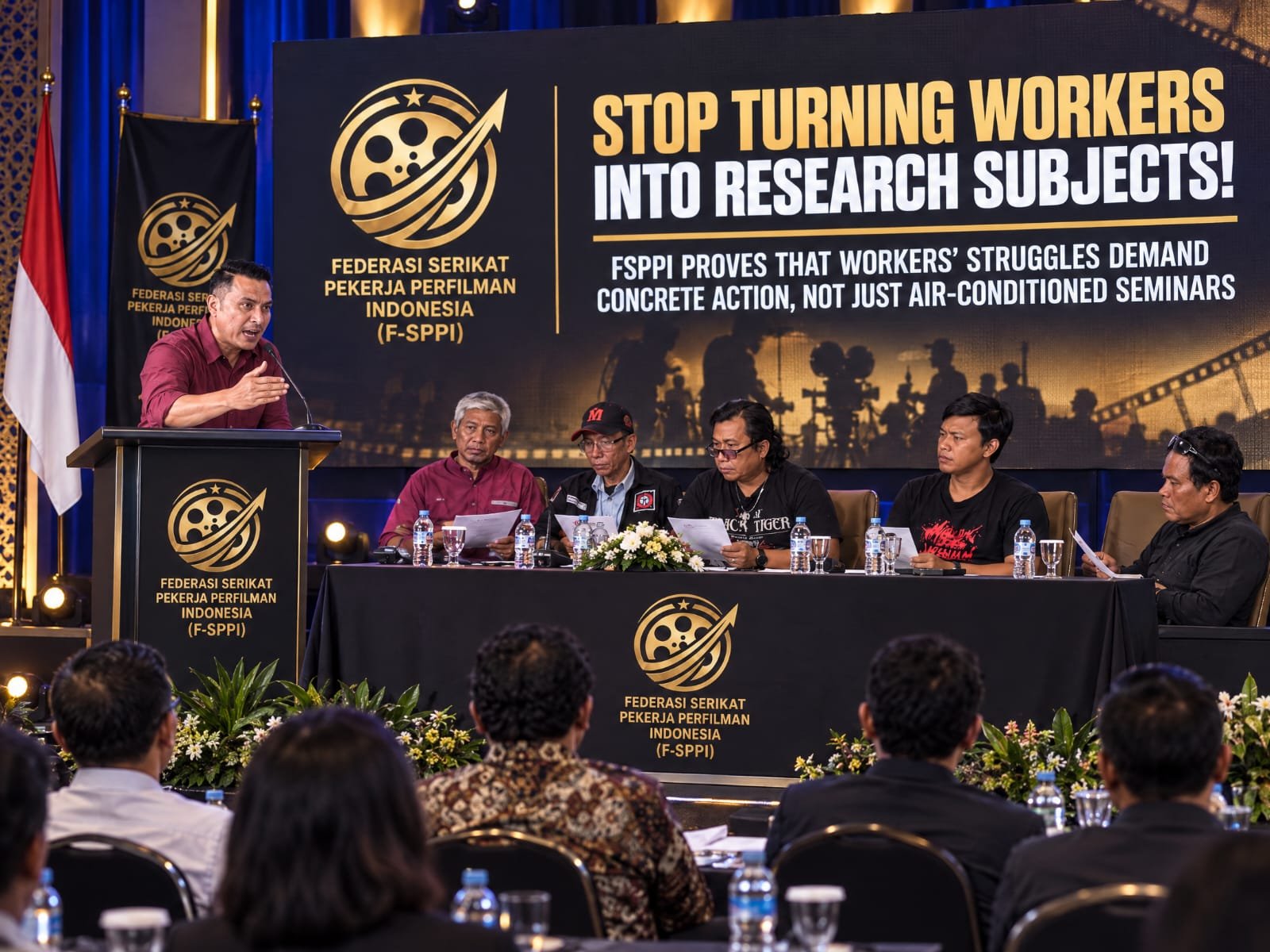
JAKARTA, Thewasesanews.com — Stop Turning Workers Into Research Subjects and recognize that the struggle to protect workers in the creative industries and film sector demands concrete action rather than endless academic discussions.
There is a troubling irony in the struggle to protect workers in the creative industries and film sector. While workers urgently need legal certainty, social security, and protection against occupational risks, some circles remain preoccupied with discussing workers’ hardships through research projects, seminars, workshops, and endless policy recommendations.
The question is straightforward: Will the workers’ struggle remain confined to seminar rooms, or will it advance towards concrete, legally enforceable change?
Research matters. Academics have an essential role in developing evidence-based arguments, examining labor issues, and formulating practical solutions. Non-governmental organizations (NGOs) also play an important role in defending workers’ rights. But these activities must serve as instruments for achieving meaningful change, not be treated as achievements in themselves.
Workers cannot pay their bills with seminar recommendations. They cannot rely on stacks of policy papers when confronting workplace accidents, income insecurity, or the absence of adequate social protection.
Workers need real protection, not endless explanations of why that protection has yet to materialize.
FSPPI: ACADEMICS WHO DO NOT JUST STUDY THE STRUGGLE, BUT TAKE PART IN IT
The Indonesian Federation of Film Workers’ Unions (Federasi Serikat Pekerja Perfilman Indonesia — FSPPI) offers a different model of the relationship between intellectual work and the labor movement.
FSPPI brings together academics who are directly involved in the struggle for workers’ rights. They do not stand at a distance as observers analyzing workers’ problems from the sidelines. They take part in organizational work, advocacy, worker mobilization, and efforts to advance policy change.
This is a lesson for anyone who claims to stand with workers: being an academic does not require standing apart from the struggle, and being a labor activist does not mean abandoning knowledge and scholarship.
The two can reinforce one another. Academic knowledge provides an evidence-based foundation for advocacy, while direct involvement in the workplace and the labor movement ensures that analysis remains grounded in the realities workers face every day.
FSPPI demonstrates that academic expertise can move beyond discussion rooms and become a practical instrument in the struggle for film workers’ rights. Intellectual work is not merely the ability to explain injustice. It is also the willingness and capacity to help build a path towards overcoming it.
This criticism is not directed at all academics or every NGO. It is directed at a model of activism that treats research, seminars, and policy recommendations as the finish line, without ensuring that their findings translate into meaningful policy changes.
Workers must not be valued only when their data are collected, their experiences are documented, or their stories are turned into publications—only to be forgotten when those findings need to be turned into enforceable protections.
TOGETHER WITH KSPSI AGN AND KBPBI, TAKING THE WORKERS’ STRUGGLE INTO THE LEGISLATIVE ARENA
The struggle to protect film workers cannot be separated from collective action. FSPPI, together with KSPSI AGN and the Indonesian Grand Coalition for the Workers’ Struggle (Koalisi Besar Perjuangan Buruh Indonesia — KBPBI), has pursued efforts to ensure that workers’ demands receive attention in the national labor policy agenda.
One development highlighted by the labor movement is the reported inclusion of demands concerning workers in film, the arts, and the creative economy in a provision identified as Article 95B(1)(l) of the newly enacted labor legislation.
For the film workers’ movement, the accommodation of these demands represents an important development. Film and creative-sector work often operates on a project-based basis, with employment arrangements that do not always follow conventional patterns. These conditions require serious policy attention so that workers are not continually left in precarious and vulnerable positions.
This struggle reinforces a fundamental principle: film workers must no longer be pushed to the margins of labor policy discussions. Their demands for legal protection and social security must become part of the national agenda.
However, the struggle does not end when legislation is passed. The precise wording of the provision, its implementing mechanisms, access to social security coverage, and workers’ practical ability to exercise their rights must all be closely monitored.
The enactment of legislation is an important milestone. Ensuring that workers actually receive its protection is the real test of success.
This is where trade unions play a crucial role: organizing workers’ demands, strengthening the arguments for reform, engaging decision-makers, and ensuring that legal provisions do not remain empty words on paper.
A CHALLENGE TO A LABOR MOVEMENT THAT HAS BECOME TOO COMFORTABLE IN SEMINAR ROOMS
To those who devote themselves to researching the labor movement, one question deserves a direct answer: When the research is over, what has actually changed?
Have the recommendations been translated into policy? Have the findings strengthened workers’ bargaining power? Have workers gained better access to protection? Or does the process end when the report is submitted, the photographs are taken, and the meeting is adjourned?
These questions are not a rejection of scholarship. On the contrary, they demand that knowledge fulfill its social responsibility and produce outcomes for which its advocates can be held accountable.
The number of seminars held must never become the primary measure of a movement’s success. A forum may generate excellent ideas, but those ideas still require follow-through, a clear advocacy strategy, and the determination to fight for them before those who hold political and legislative power.
Do not merely map workers’ suffering. Join the struggle to overcome it. Do not simply explain inequality. Help advance changes that reduce it.
There is a fundamental difference between those who merely document workers’ problems and those who commit themselves to the struggle—organizing, mobilizing, building solidarity, and pressing for change.
Workers do not need a movement that grows loud during seminars but falls silent when it is time to fight for policy change.
WORKERS ARE NOT RESEARCH SUBJECTS. THEY ARE THE DRIVING FORCE OF THEIR OWN STRUGGLE.
FSPPI, together with KSPSI AGN and KBPBI, places workers’ protection at the center of a collective struggle that demands concrete action. The participation of academics within FSPPI also demonstrates that intellectual capacity and active engagement in the labor movement can go hand in hand.
The message is not that seminars are useless, that research should stop, or that academics and NGOs have no place in the labor movement. High-quality research remains necessary. Academics continue to have a strategic role. NGOs can also make valuable contributions to strengthening workers’ organizations and advancing labor rights.
But all these efforts must have a clear purpose: strengthening workers’ collective power, advancing policy change, and ensuring that protection reaches the people who need it.
The success of a labor struggle cannot be measured solely by the number of events held, the volume of publications produced, the thickness of reports, or the breadth of professional networks established. It must also be measured by policy changes, stronger labor rights, and the effective implementation of protections that workers can actually access and exercise.
FSPPI affirms a fundamental principle: knowledge must be willing to enter the field, advocacy must lead somewhere, and the workers’ struggle must deliver tangible protection.
Do not use workers merely as sources of data. Do not turn their suffering into research material alone. And do not claim solidarity if your commitment ends when the seminar is over.
Workers are not objects to be endlessly observed and analyzed. They are people whose rights must be defended and the principal agents of the changes that shape their own lives.
Do not merely study the labor movement. Become part of the movement that fights for workers’ rights. Do not merely talk about protection. Organize, mobilize, and hold those in power accountable until that protection becomes a reality.
SOLIDARITY IS NOT A SEMINAR. SOLIDARITY IS ACTION. WORKERS’ RIGHTS MUST BE FOUGHT FOR, WON, AND DEFENDED.
Key Entities: Federasi Serikat Pekerja Perfilman Indonesia (FSPPI), KSPSI AGN, Koalisi Besar Perjuangan Buruh Indonesia (KBPBI).