

JAKARTA, thewasesanews.com — Senior labour activists strengthen film workers unions foundations as the Indonesian Federation of Film Workers’ Unions (F-SPPI) formally engages senior academics and trade unionists with extensive experience in education, research, organizing, workers’ rights advocacy, and international labour movements, Sunday (9/8/2026).
Their engagement forms a core part of F-SPPI’s strategic effort to build a film workers’ federation that is not only organisationally strong at the national level, but also grounded in knowledge, workers’ education, research, industrial relations, and international labour perspectives.
Through this comprehensive approach, F-SPPI seeks to connect the real experiences and aspirations of Indonesian film workers with broader developments in the labour movement across the region and internationally.
The senior academics and labour activists contribute directly through knowledge exchange, organizational experience, workers’ education, research, capacity building, and perspectives on building democratic, independent, sustainable, and effective trade unions capable of advancing workers’ rights and interests.
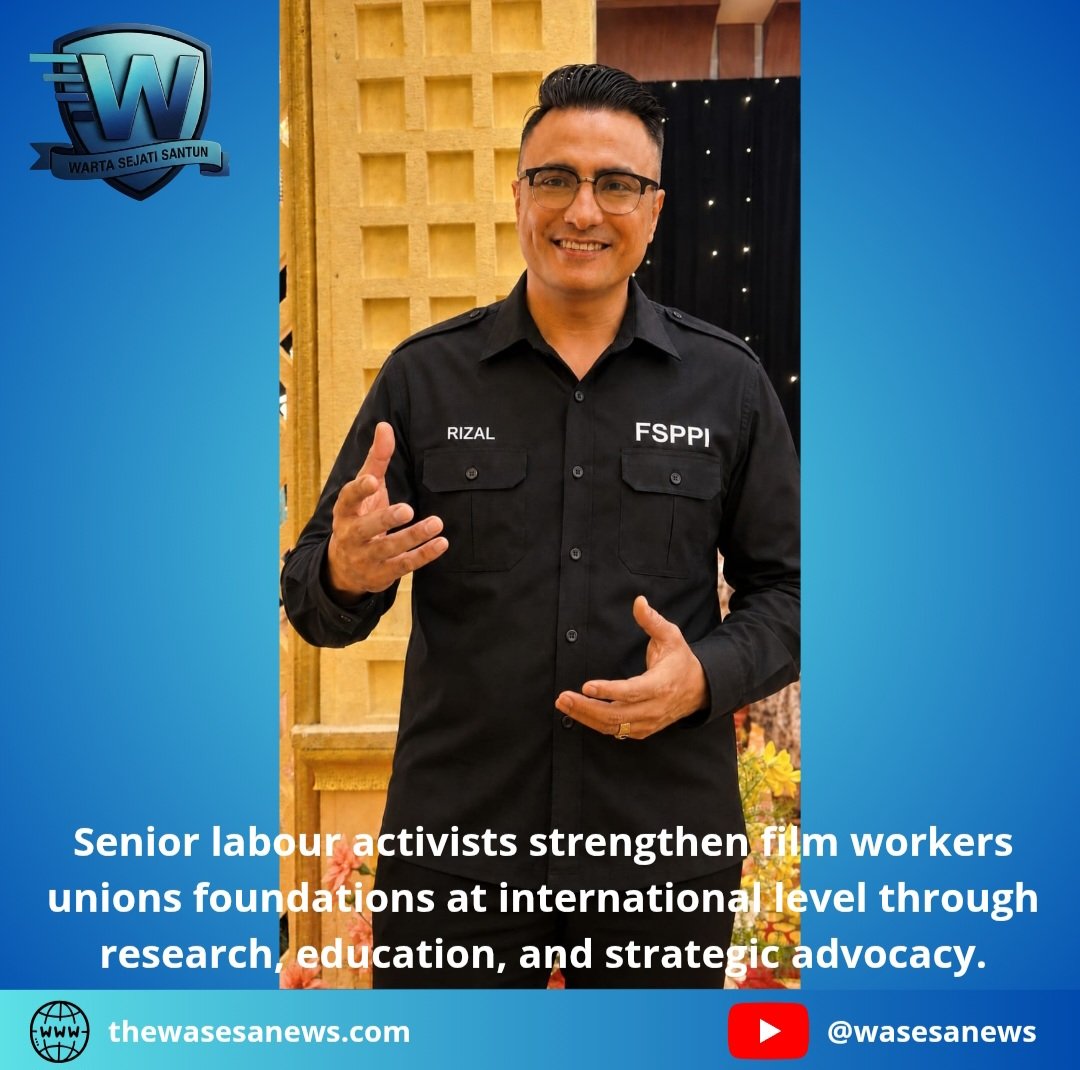
General Chairperson of F-SPPI, Dr. Rizal Djibran, emphasized that the involvement of these experienced figures brings invaluable resources to the organization’s core foundation.

“The involvement of these senior academics and labour activists is highly significant for us. They bring not only academic expertise, but also decades of experience dedicated to educating workers, conducting research, building capacity, and advancing labour issues at the regional level. That accumulated experience and knowledge is an important resource for strengthening the foundations of the Indonesian Federation of Film Workers’ Unions,” said Dr. Rizal Djibran, General Chairperson of F-SPPI.
Dr. Rizal Djibran stressed that the development of F-SPPI must not stop at establishing organizational structures and formal institutions alone.
Organisational development, he noted, must be accompanied by the development of knowledge, workers’ education, research, leadership, organizing capacity, and systematic advocacy.
“We want F-SPPI to be built not only on organisational structures, but also on knowledge, research, education, and the accumulated experience of the labour movement. Our engagement with regional academic and labour networks is therefore an important part of strengthening the federation’s capacity to understand the challenges facing film workers from a broader perspective, including the transformation of the industry, digitalisation, artificial intelligence, and changing employment relationships at the global level,” he added.
The ongoing transformation of the film industry and the wider creative economy has created increasingly complex labour and employment challenges across all production sectors.
Digitalisation, platform-based production, artificial intelligence, changing forms of work, the protection of women and child workers, occupational safety and health (OSH), employment contracts, fair wages, social protection, and intellectual property rights are issues that can no longer be separated from the broader transformation of the global industry.
Against this complex backdrop, F-SPPI views the development of international networks not simply as a routine expansion of organizational relations, but as an integral part of institutional capacity building.
Communication and cooperation with trade unions, international workers’ organisations, labour institutions, academics, and organisations engaged with the film and creative industries provide vital spaces for exchanging experiences, strengthening knowledge, and developing shared strategies.
Deputy General Chairperson of F-SPPI, Zulfikar, highlighted how this expertise enriches the federation’s strategic vision and long-term institutional stability.
“The involvement of these senior academics and labour activists brings an important additional dimension to F-SPPI. They bring decades of experience in building knowledge, educating workers, conducting research, and advancing labour issues at the regional level. For us, that experience is an important foundation for strengthening the federation’s institutional capacity,” said Zulfikar, Deputy General Chairperson of F-SPPI.
Zulfikar added that this accumulated experience should also become an essential bridge through which a new generation of Indonesian film workers can better understand developments within the labour movement across the region.
“We hope that their experience and networks will serve as a bridge for F-SPPI to learn from developments in workers’ movements across the region and to build meaningful international cooperation. At the same time, we want to ensure that this knowledge does not remain within a single generation, but is transferred to a new generation of Indonesian film workers,” he said.
F-SPPI clarified that the engagement of senior academics and labour activists is not intended to take over F-SPPI’s organizational processes or internal leadership.
Their role is specifically designed to strengthen the federation’s knowledge base, contribute strategic experience, create opportunities for learning, and support the development of the next generation of film workers’ leaders.
Through this balanced approach, F-SPPI aims to grow as a federation with its own clear identity, leadership, and organizational independence, while remaining fully open to knowledge exchange and developments within the labour movement at regional and global levels.
The General Chairperson of F-SPPI re-emphasized that the transfer of knowledge and experience represents a vital long-term investment in building a stronger organization for Indonesian film workers.
“For us, this is not about who is the most senior or who has spent the longest time in the movement. It is about how the experience and knowledge built over decades can be transferred to a new generation of Indonesian film workers. We want to build a federation that is firmly rooted in Indonesia while maintaining a broad outlook and meaningful connections with the international labour movement,” he stressed.
F-SPPI also places rigorous research and workers’ lived experiences at the very heart of its organizational development process.
Knowledge emerging directly from workers’ real experiences in the workplace is expected to become the solid foundation for workers’ education, organizing, advocacy, and the formulation of policy recommendations.
“F-SPPI must be an organisation capable of transforming workers’ experiences into knowledge, knowledge into organisational strength, and organisational strength into policies that protect workers. This is where we see the importance of engaging senior academics and labour activists in laying the foundations of this federation,” concluded the General Chairperson of F-SPPI.
This forward-looking approach demonstrates that building a federation of film workers is not solely about establishing organizational structures.
It is equally about developing institutional capacity, leadership and cadre development, workers’ knowledge, research, advocacy networks, and the collective ability to respond to long-term changes in the industry.
Looking ahead, F-SPPI seeks to become a strong representative voice for Indonesian film workers in advancing a fair, decent, safe, competitive, and sustainable working environment.
At the same time, the federation continues to create broader opportunities for Indonesian film workers to participate in dialogue, knowledge exchange, and labour cooperation at regional and international levels.
Strong organizational foundations at home, the deep knowledge and experience of senior academics and labour activists, and meaningful engagement with the international labour movement form the three strategic pillars of F-SPPI’s development.
Together, these pillars provide a firm foundation for building a federation in which Indonesian film workers are better organized, better informed, and equipped with stronger collective capacity to advance and defend their rights and interests.
Source: Central Executive Board of the Indonesian Federation of Film Workers’ Unions (F-SPPI)